

Previous Projects
Its what we do
Here at Ataraxia Engineering we go above and beyond to ensure customer satisfaction on every project. From Cradle to grave we will support projects to ensure smooth operation and continual success in every regard.
Project Name: Wrapping station Chain conveyor & Surrounding safety platform

Design screenshot
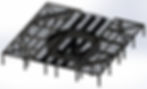
Design bottom view
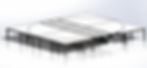
Guarded view of wrapping station
Design screenshot
This project involved the design and implementation of a chain conveyor system, developed to integrate with existing structures and constraints. A simple, bolt-together approach was used to minimise welding, improving both installation and long-term maintenance. Standard, readily available components were specified throughout to ensure ease of sourcing and overall cost-effectiveness.
The implementation phase was carefully managed to align with project timelines, with all parts ordered in advance to meet deadlines. The build is currently underway with active support provided throughout, ensuring any design queries or on-site challenges are addressed promptly to maintain progress.
Ongoing support is available for any future design changes or drawing amendments, ensuring the system can continue to evolve alongside operational requirements.
Project Name: UR20 Robot arm Extrusion frame
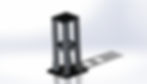
Design view
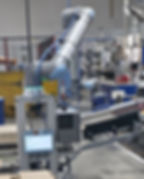
Robot stand in production
Robot stand in production
Design view
The focus for this design is creating a modular stand for a UR20 robot, combining aluminium extrusion with steel plate elements to create a strong yet adaptable structure. The use of extrusion allows for quick adjustments and easy integration of additional components such as sensors, airlines, and tooling as requirements evolve.
The design was kept practical and user-friendly, with a clear emphasis on simplicity and flexibility. Standard components were used throughout, ensuring parts are easy to source and future modifications can be carried out without difficulty.
Assembly was straightforward, supported by clear documentation and a design that required minimal effort to implement. The client completed final setup and integration, with the stand providing a reliable and scalable solution for their production needs.
Project Name: KUKA AMR Pallet stand

Design view

Production image of station
Installed frame loaded with final product awaiting AMR transport
Design view
Designed for use within a KUKA AMR system, these pallet stands were developed to meet both system specifications and client requirements. The design accommodates standard Euro pallets while also supporting custom pallet sizes through the use of a consistent base board interface.
A strong focus was placed on repeatable positioning, ensuring the AMR can approach and collect pallets reliably and without issue. The stands provide stable and accurate location, supporting smooth automated operation within the client’s cell layout.
Constructed as simple welded frames, the solution is both robust and practical. Installation was straightforward, with final positioning carried out by the client to suit their setup, resulting in an efficient and dependable system in operation.
Project Name: Motor adapter plate

Design assembly view

Installed 3D printed part on customer provided motor

Design view
Design assembly view
Developed to replace an obsolete motor configuration, this adapter plate allowed a modern motor to be fitted to an existing drilling system without the need for a full redesign. The solution retained the original setup while restoring functionality in a simple and cost-effective way.
Key considerations included matching the PCDs of both interfaces, accommodating airline routing, and ensuring compatibility with the existing drive shaft through the use of a suitable coupling. The overall thickness was carefully controlled to avoid any fouling with surrounding machine components.
The final design was optimised for 3D printing, resulting in a very low unit cost of approximately £3 per part. This provided a practical solution that avoided the need to replace complete drilling units, delivering significant cost savings across multiple heads.
Project Name: Motor cover cap reverse engineering & replacement

Old vs new motor cap shown.
Old vs new motor cap shown.
Reverse engineering was used to recreate a motor cover that was no longer available to source, demonstrating the value of accurately reproducing obsolete or hard-to-find components. By carefully measuring the original part, a precise CAD model was developed to ensure a direct replacement fit.
A 3D printed cap was supplied as a fast and cost-effective solution, allowing the client to restore functionality without the need for expensive or time-consuming alternatives. This approach highlights how reverse engineering can be used to avoid unnecessary replacement of larger systems when only a single component is required.
Full drawings were also provided, giving the client the option to manufacture a more robust version if needed, while maintaining complete control over future replacements.
Project Name: Custom 3D printed roller conveyor to suit client requirements

Sectioned design view showing all components.

Assembled outfeed system
An insert section made to allow for quick replacements and reduced material use when printing.
Sectioned design view showing all components.
Designed as a fully 3D printable roller assembly for a small parts conveyor, this solution was developed to meet the client’s specific size and application requirements while keeping costs to a minimum. The focus was on creating a simple, practical design that could be easily reproduced without reliance on machined components.
All key parts were optimised for 3D printing, allowing the client to produce replacements in-house as needed. This significantly reduces lead times and eliminates the need for custom sourcing, giving full control over maintenance and spares.
Despite the use of printed components, durability remained a key consideration, resulting in a robust design suitable for regular use. The final solution provides a low-cost, flexible system that is easy to maintain and adapt as requirements evolve.
Project Name: Gantry system

Solidworks image

Final assembled system

Assembled tooling head
Solidworks image
Designed as a cost-effective alternative to a failed robotic handling system, this gantry solution was developed to automate the transfer of boards into a processing machine while maintaining flexibility for future adaptation. Built primarily around aluminium extrusion, the structure provides a modular and easily adjustable platform that can be modified to suit changing production requirements.
The system utilises a linear track with a tooling plate and linkage arrangement to create controlled Z-axis movement, allowing suction cups to accurately pick up and transfer boards during operation. Simplicity, maintainability, and operator usability were key priorities throughout the design process.
By replacing the original robot system, the client avoided replacement costs exceeding £60,000, with the complete gantry solution delivered at approximately £15,000. The final system is significantly easier to maintain, quicker to repair, and more user-friendly for day-to-day operation while still meeting the required production demands.
Project Name: Reverse engineered forming rollers.
Roller in production run
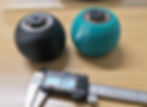
Post print rollers ready for production run
Roller in production run